Short-Term Rental Rules in the Coachella Valley: Which Cities Allow It and Which Have Banned It
Which Coachella Valley Cities Allow Short-Term Rentals?
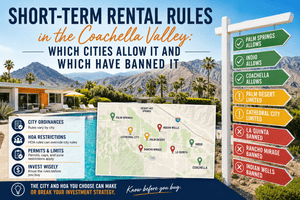
Short-term rental rules in the Coachella Valley vary dramatically by city — and in many cases by zone and HOA within a single city. Palm Springs still allows vacation rentals with a permit, but limits bookings to 26 contracts per year as of January 2026. La Quinta, Rancho Mirage, and Indian Wells have banned or stopped issuing new STR permits entirely. Indio and the City of Coachella allow rentals with annual permits. Palm Desert and Cathedral City permit STRs only in specific zones and qualifying HOAs. If you're buying a Coachella Valley home as a vacation rental investment, the city and HOA you choose determines whether your entire strategy is legal before you host a single guest.
By James Suer | July 13, 2026
The Coachella Valley draws more than 14 million visitors a year. Short-term rental income is a real part of many homeowners' financial picture here, and the demand from buyers who want to buy a vacation property that "pays for itself" is consistent. What those buyers often don't know until after they've signed escrow paperwork is that the rules governing short-term rentals in this valley aren't just different from city to city — they're actively changing.
Three cities have effectively banned new vacation rental permits for most buyers. One city reduced its annual booking cap right as the new year began. Another is sunsetting a whole category of permits by the end of 2026. And in every city that still allows it, a separate layer of HOA rules can cancel out the city's permission entirely.
If you're buying a home here with the intention of renting it short-term, you need to know the rules — not just for the city, but for the specific address — before you make an offer. Here's where every corner of the Coachella Valley stands right now.
The Coachella Valley STR Breakdown: City by City
The landscape shifted significantly in 2021 and 2022 when multiple valley cities clamped down on vacation rentals. It has continued to shift since then. What follows reflects current rules as of mid-2026 — but given how actively these ordinances change, confirm the specifics with each city before closing.
Palm Springs
Palm Springs remains the most permissive major city in the valley for short-term rentals. Vacation rentals are allowed with a city-issued permit, an annual registration fee of $1,046, and a 24/7 local contact with a 30-minute response capability. What changed as of January 1, 2026: the annual contract cap dropped from 36 to 26 bookings per year.
That cap matters more than it sounds. One contract equals one guest booking regardless of length — a one-night stay and a 10-night stay both count as one contract. If your STR strategy depends on high-turnover weekend bookings, you'll hit the 26-contract ceiling earlier than a host who books longer stays. A Junior Permit exists for low-volume hosts who want up to 6 contracts annually at roughly half the permit cost.
Palm Springs also caps vacation rental certificates at 20% of total residential units per neighborhood. When a neighborhood hits that threshold, the city stops issuing new standard certificates. In some popular areas, that cap is already met — which means even if the city allows STRs broadly, your specific address may be on a waitlist.
La Quinta
La Quinta placed an indefinite ban on new standard and primary vacation rental permits in May 2021. That ban is still in effect. Most buyers purchasing a La Quinta home today cannot legally operate it as a traditional short-term rental.
There are narrow exceptions, updated in January 2024. The Homeshare permit allows owners to rent their home if they occupy the property throughout the guest's entire stay — meaning you're hosting, not renting and leaving. The Large Lot exception applies to parcels of 25,000 square feet or more, but it requires City Council approval at a public hearing, which isn't guaranteed. STRs are still allowed in the SilverRock Resort plan area and in tourist-commercial or village-commercial zoning, but most residential buyers aren't purchasing in those zones.
La Quinta is building out the SilverRock area as the Talus development with a new ownership group. If you're interested in that area as an investment buyer, it's worth a separate conversation — the zoning there operates differently from the rest of the city.
Rancho Mirage
Rancho Mirage has a full ban on short-term rentals, effective July 1, 2022. You cannot rent any dwelling unit — in whole or in part — for fewer than 28 consecutive days. Advertising a property for a stay under 28 days is also prohibited, regardless of whether any rental actually occurs. Fines start at $5,000 per citation and escalate to $10,000 for each subsequent violation. Citations can be issued simultaneously to the property owner, property manager, and occupants.
There's no permit to apply for, no exception process, and no path to a legal short-term rental in a standard residential zone in Rancho Mirage. If you're buying there, it's a long-term rental or primary residence situation.
Palm Desert
Palm Desert's rules depend heavily on which zone your property is in. STRs are banned in R1 and R2 residential zones — where most single-family homes sit — unless you're the on-site owner and applying for a homeowner permit. STRs are allowed in RE (Residential Estate), R3 (Multi-family), and in HPR (Hillside Planned Residential) and PR (Planned Residential) zones — but only with a written HOA approval letter on file with the city.
A significant deadline is approaching: off-site STR permits in HPR zones will terminate permanently on December 31, 2026, and cannot be renewed after that date. If you're evaluating a Palm Desert vacation rental property that currently operates under an HPR off-site permit, that income stream ends this year.
Cathedral City
Cathedral City passed Ordinance 842 in October 2020, beginning a phase-out of short-term vacation rentals in most residential areas. New STVR permits are now available only in two circumstances: Homeshare (owner occupies the home as a primary residence and is present during all guest stays) or qualifying HOA properties in Resort Residential (RR) zoning where the HOA's CC&Rs explicitly permit short-term rentals.
If you're buying a non-owner-occupied investment property in Cathedral City, verify that it's in RR zoning and that the HOA allows STVRs in writing before counting on rental income. The 12% transient occupancy tax applies to all qualifying stays of 30 days or fewer.
Indio
Indio allows short-term vacation rentals with an annual permit and a business license. The STVR permit runs $1,633 per year and requires annual renewal. You'll also need to remit a 1% GPSTBID assessment on gross rental revenue and collect applicable transient occupancy taxes.
The city-level permission is real — but the HOA layer is where most Indio investors hit a wall. Many Indio communities prohibit short-term rentals in their CC&Rs. Indian Palms Country Club and Resort is one of the better-known communities where select sub-HOAs within the master HOA allow vacation rentals, but you'll need to confirm with the specific sub-association for the home you're buying. Don't assume that because a neighbor is listing on Airbnb, your unit's HOA docs say the same thing.
If you're weighing timing and market conditions in Indio as part of an investment decision, it's worth reading a current look at the Indio market alongside the permitting picture.
Indian Wells
Indian Wells has stopped issuing new short-term vacation rental permits. Only properties that already hold an active permit can continue to operate. If you're buying a home in Indian Wells and the goal is vacation rental income from a new purchase, there's currently no path to a permit.
Desert Hot Springs
Desert Hot Springs allows short-term rentals with a city permit, but the city imposed two significant restrictions in October 2023: a cap of 4% of total residential properties being permitted as vacation rentals, and a 500-foot separation requirement between permitted STR properties. Both limits can restrict permit availability depending on your specific neighborhood's current count of permitted rentals. Check the local permit density before counting on availability.
City of Coachella
The City of Coachella is currently the most investor-friendly STR environment in the valley. A business license is required, and operators collect a 13% transient occupancy tax on all rentals. The city has streamlined its permitting process and eliminated mandatory inspections, making it relatively accessible for investors.
The Coachella STR market is heavily event-driven — particularly around the spring festival season, when April revenue averages roughly $11,000 per property per month for active rentals. Summer months see that number drop significantly, which makes property selection and revenue underwriting important for anyone buying as a vacation rental investment. But of all the cities in the valley, Coachella presents the clearest regulatory path for new investment buyers right now.
Bermuda Dunes (Unincorporated Riverside County)
Bermuda Dunes sits in unincorporated Riverside County, so county rules apply rather than city ordinances. You need a Riverside County STR certificate, which is issued after your application is approved and the property passes a code enforcement inspection. Certificates require annual renewal and do not transfer with the property — a new owner must apply for a new certificate. The minimum rental stay is two nights, quiet hours run from 10pm to 7am, and a 10% transient occupancy tax is collected and remitted to the county quarterly. Approximately 120 permitted vacation rentals are currently operating in Bermuda Dunes.
The Layer Most Investors Miss: HOA Rules
City permission and HOA permission are two separate decisions — and both need to say yes for your rental strategy to be legal.
Most HOAs in the Coachella Valley prohibit rentals of fewer than 30 days in their CC&Rs. This is true even in cities that broadly allow STRs at the municipal level. A Palm Springs vacation rental permit doesn't override a Palm Springs HOA that bans short-term stays in its governing documents. An Indio city permit doesn't override the prohibition buried in page 47 of a community's CC&Rs.
The HOAs that do allow short-term rentals are the exception, not the rule. In Palm Desert, PR and HPR zone properties require a written HOA approval letter — meaning the HOA's position is a gatekeeping requirement that the city itself has built into the permit process. In Cathedral City, qualifying STVRs require the HOA to explicitly allow them in its CC&Rs.
There's also a financing consideration that most buyers don't anticipate. Some properties in HOAs that are heavily used as STRs may be classified differently by lenders, potentially requiring non-conventional loan products with higher down payment requirements and different interest rate structures. If you're financing the purchase, confirm your loan type will work for the property before you're deep into escrow.
For a broader perspective on how communities across the valley differ — not just in STR rules but in character, price range, and ownership profile — the Coachella Valley city comparison guide on this blog gives a useful overview before you narrow your search.
What's Changing — and What Investors Need to Watch
The regulatory environment across the Coachella Valley has been moving in one consistent direction for the last five years: more restrictions, fewer permits, narrower exceptions. Understanding what's already changed — and what's actively changing now — is as important as knowing today's rules.
Palm Springs: 26-contract cap (January 2026). The reduction from 36 to 26 annual contracts went into effect for all permit holders at the start of 2026. Revenue projections built on the old cap are now overstated for anyone running a high-turnover booking model.
Palm Desert: HPR off-site permit sunset (December 31, 2026). All off-site STR permits in Hillside Planned Residential zones expire permanently at the end of this year. If you're evaluating a Palm Desert STR on this permit type, you're buying an income stream with a hard end date in a few months.
La Quinta: Homeshare exception added (January 2024). La Quinta created the Homeshare permit pathway in January 2024 — meaning owner-occupants who are present during guest stays can now access a permit. This is meaningful for buyers who intend to live in their La Quinta home and want occasional rental income, but it doesn't open the door for traditional non-occupied vacation rental investment.
If you're buying as an investment buyer in this market, factor regulatory risk into your underwriting. A permit that exists today may not exist — or may be significantly restricted — in three years. The cities that have already banned new permits gave little notice when they did it. The cities that haven't banned them yet have been watching the ones that did.
The difference between a profitable vacation rental investment in the Coachella Valley and a legal liability often comes down to the details: the city, the zone, the HOA documents, and the permit availability on that specific parcel. Those details are what I check for buyers before we write an offer on any property where STR income is part of the plan.
If you're looking at a specific home and want to know the real picture on its STR feasibility — city rules, HOA restrictions, permit availability — reach out directly before you get attached to a property that won't work for your strategy. Call or text me at 760.501.0270 or email james@homemadejsre.com.
Frequently Asked Questions
Can you run an Airbnb in La Quinta, CA?
La Quinta has an indefinite ban on new standard and primary STVR permits, in effect since May 2021. New vacation rental permits are only available for Homeshare operators (where the owner occupies the property throughout the guest's stay) or properties on large lots of 25,000 square feet or more that receive Council approval. STRs are still permitted in the SilverRock Resort plan area and tourist-commercial or village-commercial zoning.
Which Coachella Valley city is best for short-term rental investment?
Palm Springs and the City of Coachella are currently the most permissive. Palm Springs allows vacation rentals with a permit but limits operators to 26 contracts per year as of January 2026. The City of Coachella has the most streamlined permitting process in the valley and allows STRs broadly, with strong event-driven demand during festival season. Indio also issues new permits with HOA confirmation. Rancho Mirage, Indian Wells, and La Quinta have largely eliminated the option for most investment buyers.
Do HOA rules affect short-term rentals even if the city allows them?
Yes — and this is where most investors make their biggest mistake. A city permit does not override HOA restrictions. Most HOAs in the Coachella Valley prohibit rentals of fewer than 30 days in their CC&Rs. Even in investor-friendly cities like Indio or Palm Springs, many individual communities ban short-term rentals at the HOA level. You must review the specific community's CC&Rs and current HOA policies before writing an offer on any property you plan to rent short-term.
How many short-term rental contracts are allowed in Palm Springs per year?
Palm Springs limits STR operators to 26 rental contracts per calendar year, effective January 2026 (reduced from the previous 36-contract cap). One contract equals one guest booking regardless of length — a two-night weekend and a two-week stay each count as one contract. A Junior Permit allows up to six contracts per year at roughly half the standard fee and is not counted against neighborhood density caps.
Can you get a new short-term rental permit in Indio?
Yes. Indio currently issues new STVR permits to qualifying applicants. You'll need an annual STVR permit ($1,633 per year) and a city business license. You must also confirm that your specific property's HOA allows short-term rentals — the city permits it, but many Indio HOAs do not. Indian Palms Country Club and Resort is one of the more well-known communities where select sub-HOAs permit vacation rentals, but confirm with the specific sub-association before relying on that.
Short-term rental rules across the Coachella Valley are specific, local, and changing. The right question to ask isn't "Is STR legal in this valley?" — it's "Is STR legal at this exact address under this HOA?" That's a question worth asking before you write a check, not after you close escrow.
I work with buyers throughout the valley and walk through the STR feasibility picture as part of every investment buyer consultation. Reach out at 760.501.0270 or james@homemadejsre.com to go through the specifics on any property you're considering.
About James Suer
James Suer is a Realtor serving the Coachella Valley and surrounding areas. James is a listing expert with proven success and also specializes in helping buyers and first time home buyers navigate the process. Connect with James at 760.501.0270 or james@homemadejsre.com. DRE #02127314